Showing posts with label Aiko Melendez. Show all posts

Thursday, February 8, 2018

Braintwister: Of Love and Fiction


Mr. & Mr. Vol. 23 No. 39, February 8, 2000
On the cover: Jomari Yllana and Aiko Melendez

On Braintwister, some trivia questions on “Love and Fiction.”


Also in this Mr. & Ms. February 8, 2000 issue is a short story titled “The Heritage.”


“The wicked have laid a snare for me, yet I have not strayed from Your precepts. Your testimonies I have taken as a heritage forever, for they are the rejoicing of my heart.” – The Book of Psalms 119:110-111, Holy Bible, The New King James Version.

Friday, December 22, 2017

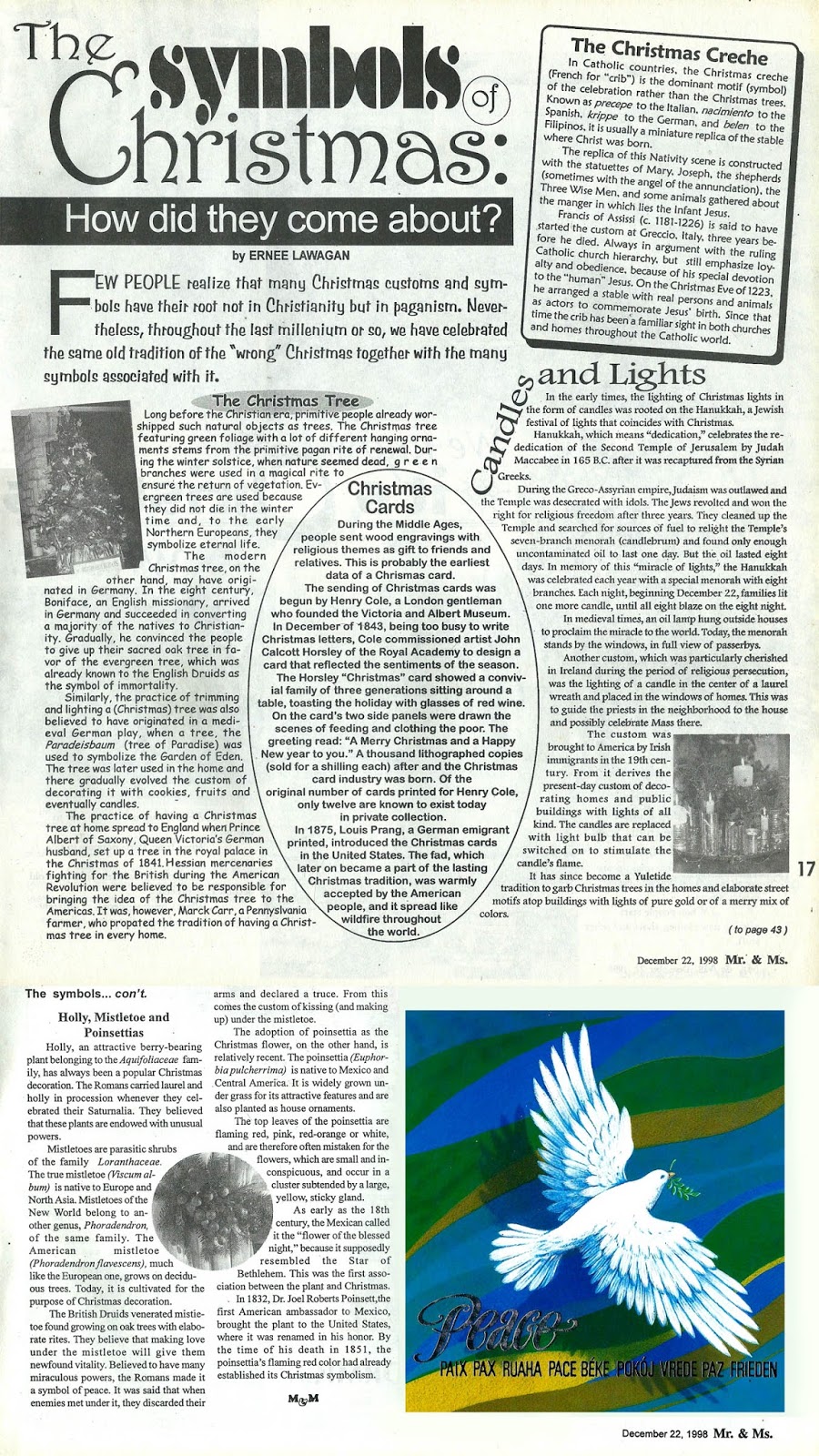
Christmas Symbols: How did they comeabout?


Mr. & Ms. Vol. 22 No. 34, December 22, 1998
On the cover: Jomari Yllana, Aiko Melendez and Their Son Andre

Many do not know that most of the Christmas traditions and symbols that they are accustomed to were not based on biblical Christianity.

“The religion of these people is worthless. A tree is cut down in the forest; it is carved by the tools of woodworkers and decorated with silver and gold. It is fastened down with nails to keep it from falling over. Such idols are like scarecrows in a field of melons; they cannot speak; they have to be carried because they cannot walk. Do not be afraid of them: they can cause you no harm, and they can do you no good..... those who make idols are disillusioned, because the gods they make are false and lifeless.” – The Book of Jeremiah 10:3-5, 14, The Good News Bible in Today’s English Version.

Tuesday, December 12, 2017

Christmas Around the World


Mr. & Ms. Vol. 24 Nos. 32, 33 & 34, December 12, 19 & 26, 2000
On the covers: Jomari Yllana, Aiko Melendez and their son Andre (Left),
Lea Salonga (center), and
Regine Velasquez and her nephew Trista Troy and nieces Hannah and Alliyah (right).

“I have written and re-written this article – “Christmas Around the World” – several times. Of course it is updated each time, with new information gathered. (SEE Blog post – FROM THE PHILIPPINES: LET'S CELEBRATE CHRISTMAS AROUND THE WORLD)


“The Word became a human being and, full of grace and truth, lived among us. We saw His glory, the glory which He received as the FATHER’s only Son.” – The Gospel According to John 1:14, The Good News Bible in Today’s English Version.

Monday, November 13, 2017

Fiction: To Share a Dream


Mr. & Ms. Vol. 21 No. 29, November 11, 1997
On the cover: Jomari Yllana and Aiko Melendez


A short story titled “To Share a Dream.”


“There is a right time and a right way for everything, yet people often have many troubles. They do not know what the future holds, and no one can tell them what will happen.” – Ecclesiastes 8:6-7, The Everyday Bible, New Century Version.


Tuesday, June 27, 2017

Folly Tickling: Of Salmonic Decision, Poison Peddlers & Lousy College Teachers


Celebrity World Vol. 3 No. 151, June 27, 1994
On the cover: 18-year-old Aiko Melendez

In my column Folly Tickling: “Of Salmonic Decision, Poison Peddlers and Lousy College Teachers.”


“There used to be false prophets among GOD’s people, just as you will have some false teachers in your group. They will secretly teach things that are wrong – the teachings that will cause people to be lost. They will even refuse to accept the Master, Jesus, who bought their freedom. So they will bring quick ruin on themselves.” – 2 Peter 2:1, The Everyday Bible, New Century Version.

Tuesday, May 16, 2017

Let's Save Our Planet: Saving Our Bats


Mr. & Ms. Vol. 19 No. 3, May 16, 1995
On the front cover: Joey Albert with daughters Trixie and Margi.
On the back cover: Aiko Melendez in a Rexona underarm deodorant print ad.


As far as I know, this article, “Saving Our Bats” (p. 15), is the second one I wrote for Mr. & Ms. magazine and also the second for its “Let’s Save Our Planet” section.


“One thing I (Solomon) have learned: GOD made people good, but they have found all kinds of ways to be bad.” – Ecclesiastes 7:29, The Everyday Bible, New Century Version.
 

Sunday, December 16, 2012

December 16


DECEMBER 16
MOD Girl, December 16, 2005
On the Cover: Maria Denise M. Estrada

 
Disyembre 16 sa Kasaysayan ng Pilipinas

          Noong Disyembre 16, 1970, ang Philippine Business for Social Progress (PBSP) ay itinatag ng pamahalaang Marcos bilang isang pribadong institusiyon upang tumulong sa mga development programs at socio-economic projects na ang pangunahing layunin ay maiangat ang antas ng pamumuhay ng mga mahihirap sa Pilipinas. Isa itong foundation, na kauna-unahan sa Asia, ng pinagsanib ng mga corporate at community-based organizations para sa pagtataguyod ng kaunlaran.
                                                          o     O     o


Personalities and celebrities born on December 16:
1730 – Diego Andaya Silang, hero and revolutionary leader, in Aringay, Pangasinan (d. May 28, 1763).
1925 – Kerima Polotan-Tuvera (birth name Putli Kerima Polotan), fictionist, essayist, journalist and author a.k.a. Patricia S. Torres – in Jolo, Sulu (d. August 19, 2011).
1933 – Gloria Romero (real name Gloria Borrego Galla), award-winning actress – in Denver, Colorado.
Gloria Romero
(Noong siya ay nagdadalaga pa lamang,
mula sa pahina ng Hiwaga Komiks, Marso 7, 1956)

1968 – Kenneth Cobonpue, award-winning industrial designer – in Cebu. 

1975 – Aiko Melendez (birth name Aiko Shinoji), actress and politician – in Quezon City.


Aiko Melendrez
on the cover of Celebrity World (June 27, 1994).


THE TRUTH ABOUT SANTA CLAUS

          Every Christmas, people, especially children, often talk about “Santa Claus.” In some countries, children are still made to believe that if you hang socks near the chimney, Santa Claus will put gifts in them.


          One such example was that of Virginia O’Hanlon1 of New York City. O’Hanlon, who was then eight years old, wrote a letter that reads: “Some of my little friends say there is no Santa Claus. Papa says, ‘If you see it in The Sun, it’s so.’ Please tell me the truth, is there a Santa Claus?”
          On September 21, 1897, the New York Sun published a response through editor Francis Pharcellus Church (1839-1906): “Yes, Virginia, there is a Santa Claus.”
          Of course we all know now that this is but a wishful thought just like the ones parents tell their children wanting them to be good and polite especially during the Yuletides. But who is this Santa Claus? Is this character for real?

An illustration of Santa Claus plotting his flight,
on the cover of The Saturday Evening Post
(December 16, 1933).
          Movies, children stories, old wives’ tales and actual people portraying and masquerading as Santa Claus are popular happenings during the Yuletide season. The portrayal of an old, white-mustached and bearded, fat man dressed in red suit carrying a sackful of gifts; riding in a sleigh pulled by flying reindeers; and who goes down on chimneys to put gifts in socks and stockings hanged by good children, has been a “traditional” belief of many around the world.
          Sorry to tell you, however, but these are merely figments of the imagination. No, Virginia, sorry to disappoint you, but you better know the truth; there is no such person as Santa Claus. Well, perhaps not in the manner we were made to believe.
          Many researchers believe that the person of Santa Claus is really that of St. Nicholas of Myra. But even the historical background of this man and how he came to be Santa Claus is quite vague. Oftentimes, the narratives about his life were just passed from one storyteller to the other.
          The name “Santa Claus” most likely came from Sinter Klaes, Dutch for Saint Nicholas. When the Dutch Protestants settled in New Amsterdam (now New York), they brought with them many stories of the “visits” of Saint Nicholas. In their stories, Sinter Klaes was a just and benevolent magician who conjures gifts to good and polite children.
          The transformation of St. Nicholas into “Father Christmas” or “Father January” took place in Germany, then in countries where the Reformed Churches were in the majority, and finally in France. The feast day of St. Nicholas was put off from December 6 to December 25 or to New Year’s Day. But there are still Catholic areas where children hang up their socks and stockings by the chimney on the eve of December 6 so that St. Nicholas or Santa Claus may fill them with toys and delicacies. Since then, St. Nicholas has become the favorite patron saint of Catholic children around the world.
          St. Nicholas is one of the most popular saints who are not martyrs in both eastern and western Christian churches. He is said to be the patron saint of sailors, fishermen, travelers, bakers, merchants and, most especially, children. Little is known about his life except that he was Bishop of Myra in Lycia, on the coast of Asia Minor. 
          In fact, his existence is not fully attested to by historical documents. It is believed that he was born in Patara in Lycia sometime between A.D. 270 and 300. Some stories say that he made a pilgrimage as a boy to Egypt and Palestine; that he was imprisoned during the Roman emperor Diocletian’s persecution and released under Constantine’s rule. Some legends say he attended the Council of Nicaea in A.D.325. Many alleged miracles were attributed to this mysterious man. But all of these have no factual basis.
          According to the biography of another Nicholas, a sixth century abbot of the monastery of Sion near Myra, he saved three girls whom he dowered to save from the prostitution that poverty was forcing on them. St. Nicholas gave gold to each of the three girls for their dowries so that they could get married.
          Most “miracles” that reportedly occurred through St. Nicholas’ prayers happened to three individuals. Why this is so is still unexplained. If this has something to do with him, according also to legends and some artists’ portrayals, always putting three nuts or three berries on his palm, is highly speculative. Another example is the story of three court officers unjustly condemned to death but were saved by his appearance in a dream to Constantine, first Roman emperor to become a Christian.
          The sixth century Greek text Praxis de strate latis attributed to him numerous incredible feats directed toward the poor, the sick and the unhappy, travelers, merchants and children. Some account from the text related that he brought to life three children after they have been chopped into pieces by a butcher and put in a salting vat!
          Some accounts told that in 1087, Italian sailors brought his body from Myra to Bari in Apulia, a commune in Italy. This transport, commemorated on May 9 of every year, greatly increased the saint’s popularity and Bari became one of the world’s most crowded pilgrimage centers. Ironically the Vatican hierarchy announced on May 9, 1969, the scrapping of the name of St. Nicholas and that of 32 other “saints,” which include the Three Kings and St. Christopher, from the Calendarium Romanum.
          Much of Europe, however, still observed December 6, the day of St. Nicholas’ death, as a special holiday. It became the feast day that devout Christians celebrate annually. He became the patron saint of Russia and many other European countries, as well as various charitable fraternities and merchant guilds.
          St. Nicholas’ deeds were the favorite subject for liturgical plays and medieval artists, and his feast day is observed with much ceremonies. In Germany, Switzerland, the Netherlands and Belgium, men in bishop’s robes pose as St. Nicholas. They visit children, examined them on their prayers, urge them to be good, and give them gifts. As traditions and stories were passed from one generation to another, the name came to be transformed to Santa Claus.
          In reality, Santa Claus does not have the fancy costume, the flying sleigh and the magical reindeers. These were all artists’ additions to brighten and enliven the legends behind this obscure character. It is not even verified that he had a snow-white mustache and beard. However, the legends continue to flourish and appeal not only to the wild imagination of children but also to adults alike throughout the world.
          In 1823, American writer Clement Clarke Moore (1779-1863) even gave names to Santa’s eight reindeers (Blitzen, Comet, Cupid, Dancer, Dasher, Donner, Prancer and Vixen) in his poem A Visit From St. Nicholas.
          Whatever traditions or stories about Santa Claus that have been passed to us are not really important. Let us be good (not only this Christmas season but everyday) not for any fictional or legendary character, but for God, for our family, for our fellowmen and for ourselves.
(1) According to Edward P. Mitchell’s book Yes, Virginia, There is a Santa Claus, Virginia O’Hanlon received a master’s degree from Columbia University in 1911, married and devoted her life to teaching and working with chronically ill children.


Tampok sa taklob-pahina ng
Literary Song-Movie Magazine
(December 16, 1959) sina
Gloria Romero, Susan Roces,
Amalia Fuentes at Barbara Perez
(para sa pelikulang Wedding Bells).
Larawang Tribiya
          Alam niyo ba na nagkasama sa isang pelikula sina Gloria Romero, Susan Roces, Amalia Fuentes at Barbara Perez? Ito ay sa pelikulang ginawa ng Sampaguita Pictures na Wedding bells (1959) sa ilalim ng direksyon ni Jose de Villa. Datapuwa’t may iba’t-ibang segment ang naturang pelikula. Kasama rin sa pelikula sina Juancho Gutierrez, Jose Mari Gonzales, Romeo Vasquez, Dolphy, atbp. Magkatambal sina Fuentes at Vasquez sa segment na “Pikot,” sina Roces at Gonzales sa “Pamamanhikan,” sina Perez at Martin sa “Kasalan,” at sina Romero at Gutierrez sa “Honeymoon.” Ipinalabas ito sa mga sinehan noong Disyembre 26, 1959.
                       o     O     o

Monday, May 7, 2012

May 7


MAY 7
Mr. & Ms. Vol. 20 No. 1, May 7, 1996
(20th Anniversary Issue)
On the cover: Jomari Yllana & Aiko Melendez


UNANG LABAS: Bituin Komiks
Ang unang labas ng Bituin Komiks,
na may petsang Mayo 7, 1949,
tampok sa taklob-pahina ang
kathang-isip ni Jose Zabala Santos
na “Sianong Sano.”
Isa sa mga pinakaunang komiks na lumabas sa sirkulasyon ay ang Bituin Komiks. Ang unang isyu nito ay inilimbag ng Ilang-Ilang Publication, Inc., at lumabas noong Mayo 7, 1949. Tampok sa taklob-pahina nito si “Sianong Siano,” na iginuhit ng maylikha nito na si Jose Zabala Santos.
Naglalaman ang unang isyu ng Bituin Komiks ng mga maiiksing comical strips katulad ng “Kataka-taka (‘Yon an Sabi)” ni Iskong Buriko, “Sianong Sano” at “Almanake ni Pepesor” ni J. Zabala Santos, “Kalawang Bakal” ni Hugo C. Yonzon, “Ang Tao Nga Naman” ni Ted S. Tenorio, “Pitong Kutitong (Di Dyanitor)” ni Altogo, “Apalatsikola” ni Menandro Martin, “Kandiro” ni Caluag, “Isang Sakong Hangin” ni Gat, “Tiks” at “Awitawa” ni Mauro “Malang” Santos, “Boroy” ni Slim Torres, at “Presenting Ponso” ni Eddie Cunanan.
Makikita rin sa mga pahina nito ang mga nobelang “Makabagong Pilipinas” ni Susana C. de Guzman, na ginawan ng script ni Pedro Enriquez Magpayo at iginuhit ni Francisco Reyes, “Dalawang Kasal” ni Pedro Enriquez Magpayo at F. Ruvivar, “Kabayong Ginto” ni Jesus S. Esguera at Ric L. Collado, at “Pitong Balakid” ni Eriberto Flores at Elmer Abustan.
Sa ilalim ng Ilang-Ilang Publication na nagkaroon ng editorial office sa 38-40 Sta. Mesa, Manila, ang Bituin Komiks, kasama ang Ilang-Ilang Komiks ay pinamahalaan ni Conrado M. Alvarez. Ang mga una nitong naging editors ay sina Jesus E. Torres, Gemiliano Pineda, at Mauro “Malang” Santos. Sa ilalim ng Ilang-Ilang Publication, tumagal ito hanggang ika-11 isyu. Sa ika-12 isyu (Setyembre 22, 1949), ang Bituin Komiks ay inilimbag ng F. J. Quiogue Publication, na nag-opisina sa 2150-2160 Azcarraga, Manila. Ang general manager ay si Felix J. Quiogue, at ang editorial team ay kinabibilangan ni Francisco Reyes bilang editor-in-chief at Virgilio S. Mariano, Mauro “Malang” Santos at Menandro Martin bilang mga associate editors.


UNANG LABAS: Redondo Komix Magasin
Ang unang labas ng Redondo Komiks,
na may petsang Mayo 7, 1963, tampok
sa taklob-pahina ang likhang-bayani na
si Palos sa "Ang Maskara ni Palos" ng
magkapatid na Virgilio at Nestor Redondo.
Mula sa pangalan ng maituturing na magkapatid na “alamat” sa larangan ng komiks – sina Virgilio at Nestor Redondo – ang titulo ng Redondo Komix. Inilimbag ito ng CRAF Publication at unang lumabas noong Mayo 7, 1963.
Tampok sa taklob-pahina ng unang isyu ang likhang-bayani ng magkapatid na Redondo na si Palos sa nobelang “Ang Maskara ni Palos.” Mula rito pumaimbulog sa kasikatan at imortal na pagtangkilik ang character na Palos, na nagpatuloy sa iba pang mga komiks, sa mga pelikula at maging sa mga teleserye ng makabagong panahon.


Events that happened on May 7
1899 – General Emilio Aguinaldo appointed  Pedro paterno as the head of his new cabinet.
1972 – The Philippine Daily Express, a national daily news magazine, released its first issue.


Personalities and celebrities born on May 7:
1892 – Tomas Claudio, First Filipino hero of World War I – in Morong, Rizal (d. June 29, 1918 in Oise, France).
1929 - Dencio Padilla (real name Dencio Baldivia), actor and comedian - in Laguna (d. October 11, 1997).

1946 – Helen Gamboa (full name Helen Alvent Gamboa), actress and singer – in Manila.
Si Helen Gamboa,
tampok sa taklob-pahina ng Bulaklak (Hiyas ng Tahanan), Enero 15, 1964.


MAKABAGONG PILIPINA
Unang pahina ng unang labas ng nobela ni
Susana de Guzman na “Makabagong Pilipina”
sa Bituin Komiks No. 01 (May 7, 1949).

          Ang terminong “Modern Filiipina” o “Makabagong Filipina” ay unang nailathala bilang isang kuwento sa Bituin Komiks No. 01 (May 7, 1949). Ito ay sa nobelang isinulat ni Susana de Guzman na may pamagat na “Makabagong Pilipina.” Pansinin na sa pagkakabaybay ay letrang “P” ang ginamit sa halip na “F.” Ito ay sa kadahilanang noong 1949 ay hindi pa ginagamit ang salitang “Filipina.”
          Ang nobela ni De Guzman ay ginawan ng komiks scripts ni Pedro Enriquez Magpayo at iginuhit o isinalarawan ni Francisco Reyes.
                             o     O     o


WIKApedia
Ano ang Pagkakaiba?
          Ano ang pagkakaiba ng Filipino sa Pilipino?
          Ang “Filipino” ay patungkol sa kasarinlan o pagkabansa. Sa madaling salita, ito ay nationality. Samantalang ang “Pilipino” ay ang wika.
          Upang lalong maintindihan, narito ang dalawang pangungusap bilang pagpapaunawa: 1. Pilipino ang wika ng mga Filipino. 2. Ang isang mamamayang Filipino ay dapat marunong magsalita ng Pilipino.
                                                          o     O     o


Pacific nuclear bomb test explosion creating
a radioactive cloud mushroom, on the cover
of Newsweek May 7, 1962 issue
Larawang Tribiya
          Alam niyo ba na mula 1946 hanggang 1962, kutakot-takot na nuclear bomb tests ang ginawa ng America sa lugar na kung tawagin ay Pacific Proving Ground, kabilang dito ang Marshall Islands. Maraming kapinsalaang ginawa ang pagpapasabog ng mga bombang nuklear na ito ng America sa mga tao at hayop na naninirahan sa mga naturang isla at sa mga kapaligiran nito. Lumaganap ang iba’t-ibang uri ng cancer at birth defects sa naturang mga lugar. Dahil dito pinagbayad ang America ng halagang umaabot sa halos 800 million dollars sa mga mamamayan ng Marshall Islands. Subalit lumipas pa ang halos apat na dekada bago naibahagi ang kabayarang ito.
          Sa Partial Test Ban Treaty (1963), ipinagbawal na ang atmospheric at underwater nuclear bomb testing, bagama’t sinasabing ipinagpatuloy pa rin ito ng mga bansang America at France.
                             o     O     o